[Small Grant] RelayStream: Native Sia Media Ingestion & Storage Orchestration Engine
Introduction
Project Name:
RelayStream Open Ingestion Engine
Applicant:
Michael Lipson | Val IT Tech Solutions
Contact:
[email protected]
X: @RelayStream_net
GitHub:
https://github.com/tvmateocmd-design/open-strm-standard
Background
Lead Systems Architect focused on real-time data synchronization, self-hosted infrastructure, and distributed media delivery workflows.
Previous development work includes the EMS Companion App, designed around real-time synchronized data systems utilizing Firebase infrastructure.
Current development efforts are focused on creating open-source tooling for decentralized media ingestion, archival organization, HLS packaging workflows, and distributed storage orchestration using Sia-native infrastructure.
Project Description
The RelayStream Open Ingestion Engine is a self-hosted media ingestion and orchestration framework designed for operators utilizing the Sia storage ecosystem.
The engine automates the process of:
-
ingesting large media files
-
converting media into HLS-compatible segmented structures
-
generating retrieval manifests
-
coordinating distributed storage uploads
-
organizing redundancy workflows
-
managing retrieval metadata
The project is intended for:
-
self-hosted media archivists
-
distributed broadcasters
-
educational archives
-
public domain preservation projects
-
independent infrastructure operators
All processing occurs server-side on operator-controlled infrastructure such as VPS servers, dedicated servers, or local self-hosted deployments.
The project does not rely on browser-side transcoding or custodial SaaS infrastructure.
Target User
The RelayStream Open Ingestion Engine is intended primarily for technical operators and power users managing self-hosted infrastructure.
Target users include:
-
self-hosted media archivists
-
independent broadcast operators
-
distributed media infrastructure researchers
-
educational archival projects
-
advanced home lab operators
-
decentralized storage developers
Because large-scale video ingestion and FFmpeg processing are compute-intensive, the system is specifically designed for VPS, dedicated server, or operator-managed infrastructure environments rather than lightweight consumer devices.
Mission Alignment
This project aligns with the Sia mission of user-owned infrastructure and decentralized storage coordination.
RelayStream is focused on enabling operators to maintain direct control over:
-
infrastructure
-
storage coordination
-
retrieval workflows
-
redundancy management
-
deployment environments
The project is specifically being redesigned around current Sia architecture expectations and Indexd-compatible workflows.
Grant Specifics
Amount Requested:
$10,000 USD
Architecture Components
Component A — Media Ingestion Pipeline
Automated FFmpeg-based ingestion pipeline that converts large media assets into segmented HLS-compatible delivery structures.
Current Proof-of-Concept Status:
-
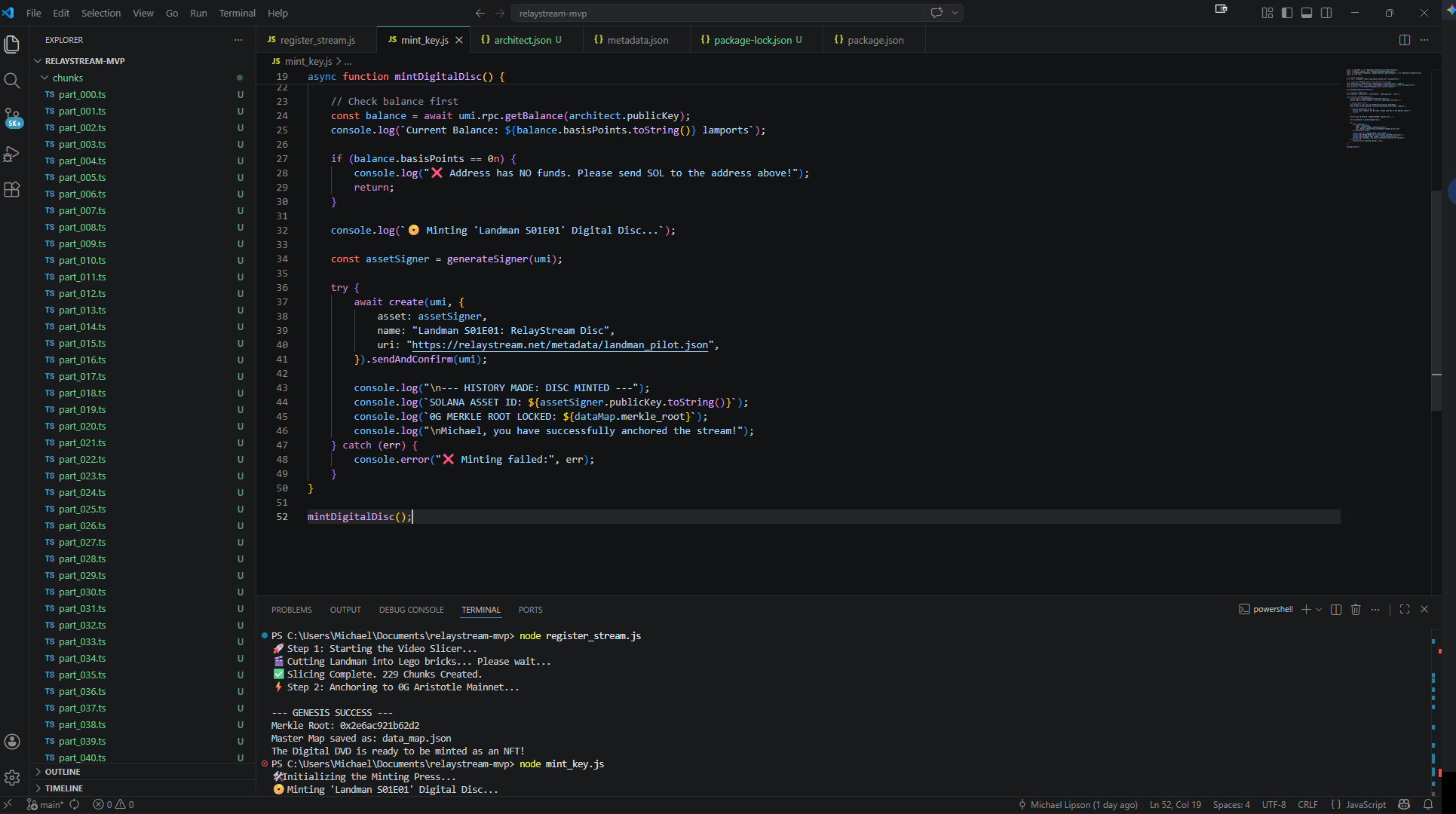
successful HLS segmentation completed
-
automated manifest generation operational
-
segmented media output confirmed
Component B — Storage Orchestration Layer
Node.js-based orchestration service responsible for:
-
coordinating uploads
-
organizing storage metadata
-
handling retrieval manifests
-
automating distributed storage workflows
-
integrating with Indexd-compatible SDK workflows
The orchestration layer is designed around self-hosted operator infrastructure and modular deployment environments.
Component C — Redundancy & Integrity Coordination
Distributed redundancy workflow coordination for archival durability and retrieval reliability.
Planned features include:
-
redundancy verification
-
integrity validation
-
retrieval consistency checks
-
distributed storage organization
The system will rely primarily on Sia-native redundancy mechanisms and operator-controlled deployment environments.
Component D — Open Documentation Standard
Creation of public open-source documentation for:
-
deployment workflows
-
ingestion pipelines
-
HLS packaging standards
-
storage orchestration setup
-
self-hosted deployment configurations
The objective is to simplify decentralized media archival workflows for the broader Sia ecosystem.
Security Best Practices
The project is designed around self-hosted and non-custodial deployment principles.
Operators retain full control over:
-
storage environments
-
deployment infrastructure
-
authentication systems
-
storage coordination workflows
All ingestion and orchestration processes occur server-side under operator-controlled infrastructure.
The project also plans to utilize existing automated storage management systems where appropriate instead of implementing unnecessary custom contract renewal systems.
Goals & Timeline
Month 1 — Core Ingestion Engine
Deliverables:
-
finalized FFmpeg ingestion pipeline
-
automated HLS packaging
-
manifest generation workflows
-
local metadata indexing
Success Criteria:
- stable automated HLS output generation
Month 2 — Storage Orchestration
Deliverables:
-
upload coordination framework
-
redundancy workflow integration
-
retrieval manifest handling
-
storage metadata organization
Success Criteria:
- successful distributed upload orchestration
Month 3 — Open-Source Release
Deliverables:
-
public repository release
-
deployment documentation
-
self-hosted setup guides
-
Docker deployment examples
-
operator installation documentation
Success Criteria:
- publicly deployable ingestion engine release
Risks & Mitigations
Storage Coordination Complexity
Mitigation:
-
modular orchestration design
-
operator-controlled deployment workflows
-
staged redundancy verification
Large Media Processing Requirements
Mitigation:
-
server-side FFmpeg workflows
-
VPS and dedicated server deployment support
-
self-hosted infrastructure model
Distributed Retrieval Consistency
Mitigation:
-
retrieval manifest organization
-
metadata validation workflows
-
redundancy verification systems
Development Information
Open Source:
Yes — MIT License
RelayStream Repository:
https://github.com/tvmateocmd-design/open-strm-standard
Proof of Prior Development Work:
https://github.com/tvmateocmd-design/EMS_Overlay_MASTER_FINAL
Post-Grant Plans
Following the grant period, development will continue as an open-source infrastructure project focused on improving decentralized media ingestion and archival workflows.
Post-grant priorities include:
-
expanding deployment tooling
-
improving distributed redundancy coordination
-
optimizing large-scale ingestion performance
-
refining metadata organization
-
building broader community documentation
-
supporting additional self-hosted deployment environments
The long-term objective is to contribute reusable open-source tooling that simplifies media archival and distributed storage orchestration for the broader decentralized infrastructure ecosystem.
Previous Experience Building on Sia
Relevant experience and development work:
-
RelayStream Sia Grant Discussion Thread: [small-grant-relaystream-native-sia-renterd-media-orchestration-ingestion-engine/1104\\]
-
RelayStream Open-STRM Repository: GitHub Repository: tvmateocmd-design/open-strm-standard
-
Sia Storage Experience & Proof of Work Demonstration:
https://drive.google.com/file/d/1VuuyzLitoo4b0RU0JrZN9Bp7imweyOox/view?usp=drive_link
Current development efforts include evaluating Sia Storage workflows, bucket organization, object management, storage contracts, decentralized storage architecture, and media ingestion tooling as part of the RelayStream Open Ingestion Engine.
The attached demonstration includes active storage contracts, bucket management, object uploads, developer documentation review, and an overview of how Sia is being evaluated within RelayStream’s decentralized media coordination architecture.
Monthly Reports
I agree to submit monthly progress reports to the forum and provide ongoing development updates regarding milestones, deployment progress, and public repository activity.