Alignment with April 2026 Grants Program Guidelines
This proposal responds directly to the Sia Foundation’s recent Q2 funding directives. SiaTrans strictly focuses on building with SDKs and building on indexd. Development is driven by the Sia Developer Portal, utilizing the official Sia Storage SDK for streaming uploads and indexd for object management.
All requirements; including open-source delivery, milestones, architecture overviews, risk mitigation, and monthly reporting, are addressed below per the Grants Development Guide.
Introduction
Project Name: SiaTrans
Organization: Dapp Mentors
Background
Dapp Mentors is a two-time Sia Foundation grant recipient and a development firm specializing in agentic automation, distributed systems, and developer tooling. We build infrastructure-grade solutions that simplify decentralized technologies.
Our previous Sia-funded work includes SiaLearn, a developer education program with hands-on projects (including VidTV, built on Sia Renterd), and SiaPeopleLearn, a decentralized educational platform hosting courses via Renterd. This track record demonstrates our proven ability to scope, execute, and deliver reliable projects within Sia’s grant terms.
Describe your project
SiaTrans is a self-hostable, open-source web application designed to seamlessly transfer, back up, and synchronize data from local systems and legacy cloud providers (Google Drive, Dropbox, URL sources) directly into the Sia Network.
Built as a single-owner deployment to prioritize data privacy, SiaTrans acts as a unified control plane for bulk data ingestion. The system relies entirely on streaming uploads via the SDK’s upload and pin_object pipeline. This ensures no persistent storage of plaintext data exists beyond temporary memory buffers.
Core Capabilities:
- Direct Ingestion: Connects to a public or private indexer endpoint for manual or automated data routing.
- Modular Features: Auto-sync, compression, preview generation, and metadata tagging are disabled by default and activated strictly by user choice.
- Secure Access: Authentication supports Google, GitHub, biometric (where available), or local passphrases, with no multi-user access vulnerabilities.
Who benefits from your project?
SiaTrans addresses the Foundation’s top-priority use case: facilitating the storage and sharing of large files without vendor lock-in.
Primary users include:
- Business Owners & Enterprise Decision-Makers: Organizations migrating large-scale datasets from centralized services (like AWS or Huggingface) into Sia, requiring open-source extensibility and bulk migration tooling.
- Content Creators & Media Professionals: Filmmakers, educators, and digital artists who need self-sovereign, censorship-resistant alternatives to costly platforms like SproutVideo for their media archives.
- Self-hosted Operators & Infrastructure Engineers: Users requiring full control over their data pipelines and backups.
- Researchers: Academics distributing massive datasets or learning materials.
- Everyday User: * Users who just want a privacy-focused provision for backing up or migrating data from legacy providers to Sia.
By unifying fragmented sources into a structured ingestion pipeline, SiaTrans delivers SaaS-grade simplicity while preserving the standards of user-owned storage.
How does the project serve the Foundation’s mission of user-owned data? What problem does it solve?
Currently, the ecosystem lacks a production-ready, intermediary-free tool for migrating large-scale data from legacy systems into Sia. SiaTrans bridges this gap.
Problems solved:
- Fragmented workflows across cloud, local, and URL-based storage.
- Data exposure risks during migration caused by temporary staging layers.
- The lack of a unified UI for bulk, multi-source ingestion.
Solution:
- Streaming-native, direct-to-Sia, bulk data transfers via the Sia Storage SDK.
- User-controlled indexer selection, incentivizing users to run their own indexers to further decentralize the network.
Compliance Questions
Are you a resident of any jurisdiction on that list? No
Will your payment bank account be located in any jurisdiction on that list? No
Grant Specifics
Amount requested: $25,600 USD
Timeline: 4 months
Budget Breakdown
| Category | Total Cost (USD) | % of Budget | Budget Justification and Primary Focus |
|---|---|---|---|
| Core application & SDK integration | $18,000 | 70.3% | Core ingestion system, Sia Storage SDK integration, resumable transfers, indexd pinning/unpinning, and secure session mechanisms. |
| Frontend Development (Dashboard UI/UX) | $3,000 | 11.7% | Self-hosted web interface, dashboard UI/UX, modular settings, and onboarding flows. |
| Infrastructure & DevOps | $2,000 | 7.8% | Environment setup, CI/CD, deployment configurations, and system observability. |
| Testing and QA | $1,100 | 4.3% | End-to-end testing, failure handling, and reliability validation. |
| Documentation & Open Source | $800 | 3.1% | Technical documentation, API references, and open-source publication. |
| Tools and Miscellaneous | $700 | 2.8% | Supporting tools, operational overhead, and contingency. |
| Total | $25,600 | 100% | — |
High-level architecture and security practices
SiaTrans utilizes a streaming-native structure aligned with the Sia Developer Portal.
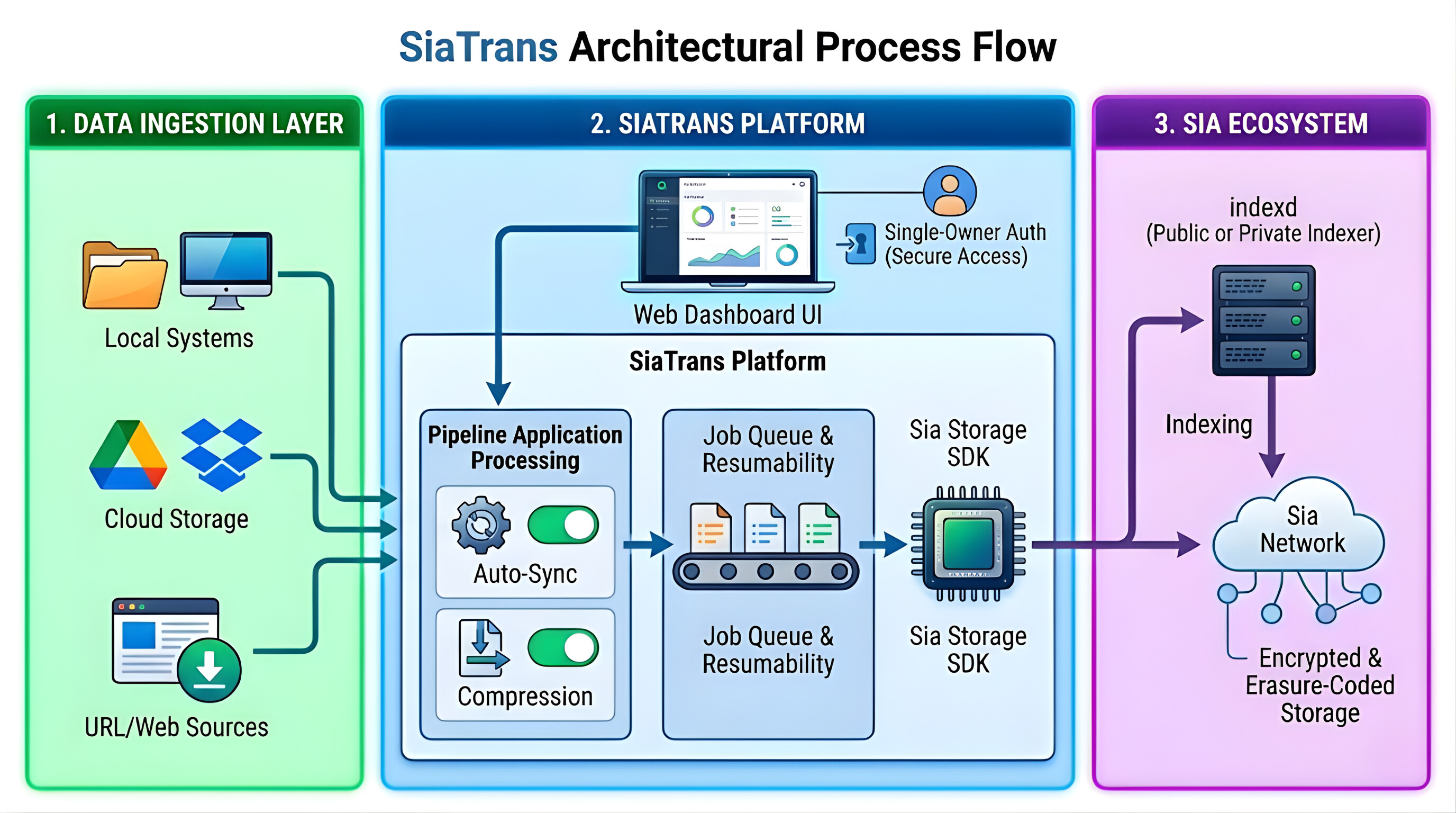
Key Security & Architecture Properties:
- Zero Persistent Staging: Encrypted streaming uploads bypass server-side plaintext storage.
- Single-Owner Access: No shared admin roles; device-bound credential storage where applicable.
- Environment-Aware: Sharing capabilities are disabled on localhost and enabled only on public deployments.
- Fault Tolerance: Configurable fallback and retry mechanisms ensure transfer continuity if an indexer becomes unavailable.
Timeline and Milestones
The project kicks off upon committee approval, with all milestones
tracked via PRs per the Grants Development Guide.
Month 1 — Foundation & Access Layer
Due: May 28, 2026
- Repo is publicly accessible on GitHub with a passing CI pipeline, README, and open-source license in place.
- Self-hosted web app runs locally with all routes resolving correctly.
- User can connect to a public or private indexer endpoint and verify the connection via the configuration module.
- Single-owner authentication is functional across all supported methods: Google, GitHub, and local passphrase.
- All four source connectors (Drive, Dropbox, local, URL) successfully surface a browsable file list in the UI.
Month 2 — Streaming Engine & SDK Integration
Due: June 28, 2026
- Files are uploaded end-to-end to Sia via the SDK streaming pipeline with no disk-side plaintext staging.
- Interrupted uploads resume from the last checkpoint without data loss; job queue state persists across sessions.
- All transfers are encrypted in transit with no intermediate server storage at any point in the flow.
- Uploaded objects are pinned via indexd; user can list and manage files directly from the dashboard.
Month 3 — Settings Modules & Workflow Enhancements
Due: July 28, 2026
- Settings-based module activation system is in place; all optional modules are disabled by default and can be independently activated via the settings panel.
- Auto-sync module runs on a configurable schedule and successfully mirrors source changes to Sia.
- Compression and deduplication worker produces a measurable reduction in upload size, logged per job.
- Preview generation produces viewable previews for supported file types prior to and after upload.
- Smart metadata enrichment (EXIF, custom tags) is extracted and visible in the object listing for eligible files.
- Metadata tagging and upload event tracking are applied and visible per object in the dashboard.
Month 4 — Hardening, Security & Release
Due: August 28, 2026
- Streaming and queue performance benchmarked with no regressions against the Month 2 baseline.
- Access controls verified and security hardening complete, with no plaintext data persisting beyond memory buffers.
- Full end-to-end test suite passes across all core user flows.
- Deployment guide and technical documentation published in the repo and accessible to the public.
- v1.0 open-source release PR merged and publicly tagged on GitHub.
Evidence of Demand
SiaTrans actively addresses the Committee’s stated focus areas while serving documented real-world needs:
- Sharing/viewing large files: The #1 item on the Committee’s list. Moving large video, photo, and dataset libraries is an enormous, unmet need for enterprise and media professionals.
- Avoiding vendor lock-in: Platforms like SproutVideo charge heavy per-seat premiums, while services like Pixeldrain lack open-source extensibility. SiaTrans provides a sovereign alternative.
- Community Validation: The demand for robust, self-hosted migration tools is highly active in communities like reddit r/selfhosted.
- Ecosystem Gap: While tools like rclone and Nextcloud offer adjacent functionality via Renterd’s S3 API, there is currently no equivalent built natively on the Sia Storage SDK + indexd stack.
Target User
- Business owners and enterprise decision-makers
- Content creators (filmmakers, educators, digital artists)
- Infrastructure engineers and self-hosted operators
- Developers building on Sia
- Researchers managing large-scale data
- Privacy focused everyday user
Post-grant plan
SiaTrans is a strategic piece of Dapp Mentors’ long-term commitment to the Sia ecosystem.
Technical Roadmap:
- v1.1 (Months 6–8): Community feedback integration, stability hardening, and SDK/indexd compatibility updates (if any).
- v1.2 (Months 9–12): Expanded multi-source pipelines and the introduction of a public API layer for enterprise business system integrations.
Community Engagement: We will utilize GitHub Discussions (technical Q&A), the Sia Discord (real-time support), the Sia Forum (progress reports), and LinkedIn/X for ecosystem visibility.
Sustainability: SiaTrans will remain 100% open-source and non-commercial, with no proprietary lock-ins or paid tiers. Future support will rely on subsequent grant applications for major architecture upgrades and our continued organizational dedication to Sia.
Risks
- SDK/indexd API changes: Mitigated via an abstraction layer that isolates SDK calls from core application logic, allowing targeted updates without major rewrites.
- Indexer availability failures: Mitigated by configurable fallback, audit trails, and retry mechanisms within the upload queue.
- Self-hosted misconfiguration: Mitigated through comprehensive documentation, sensible default settings, and a guided onboarding UI.
Development Information
Open-source Status:
Yes, SiaTrans is fully open-source. All code will be publicly licensed and accessible for review throughout development.
Leave a link where code will be accessible for review:
Agreement
Yes, we agree to submit monthly progress reports using the official Sia Foundation template.
Contact Information
Email: [email protected]
LinkedIn: https://www.linkedin.com/in/darlington-gospel