Introduction
Grant Type: Standard Grant
Project Name: ReBit – Decentralized Short Video Processing Engine
Name of the organization submitting the proposal: Dapp Mentors
Dapp Mentors is a two-time Sia Foundation grant recipient specializing in developer tooling, AI, and decentralized infrastructure. Our previous grants delivered SiaLearn and SiaPeopleLearn, both built on Renterd.
We originally submitted ReBit as a Small Grant proposal built on the indexd and Sia Storage SDK pathway. That submission landed during a period when the Grants Committee had paused new reviews. Rather than wait, we kept building. ReBit is no longer a proposal on paper. It is a working, self-hostable video processing engine with a complete six-stage pipeline, a browser-based setup wizard, passkey and OAuth authentication, and real-time progress tracking, all running against the Sia Network today.
This proposal asks for a Standard Grant to take ReBit from a working MVP to a production-ready release.
Watch the 3:24 sec demo of ReBit running end to end, from upload through Sia storage:
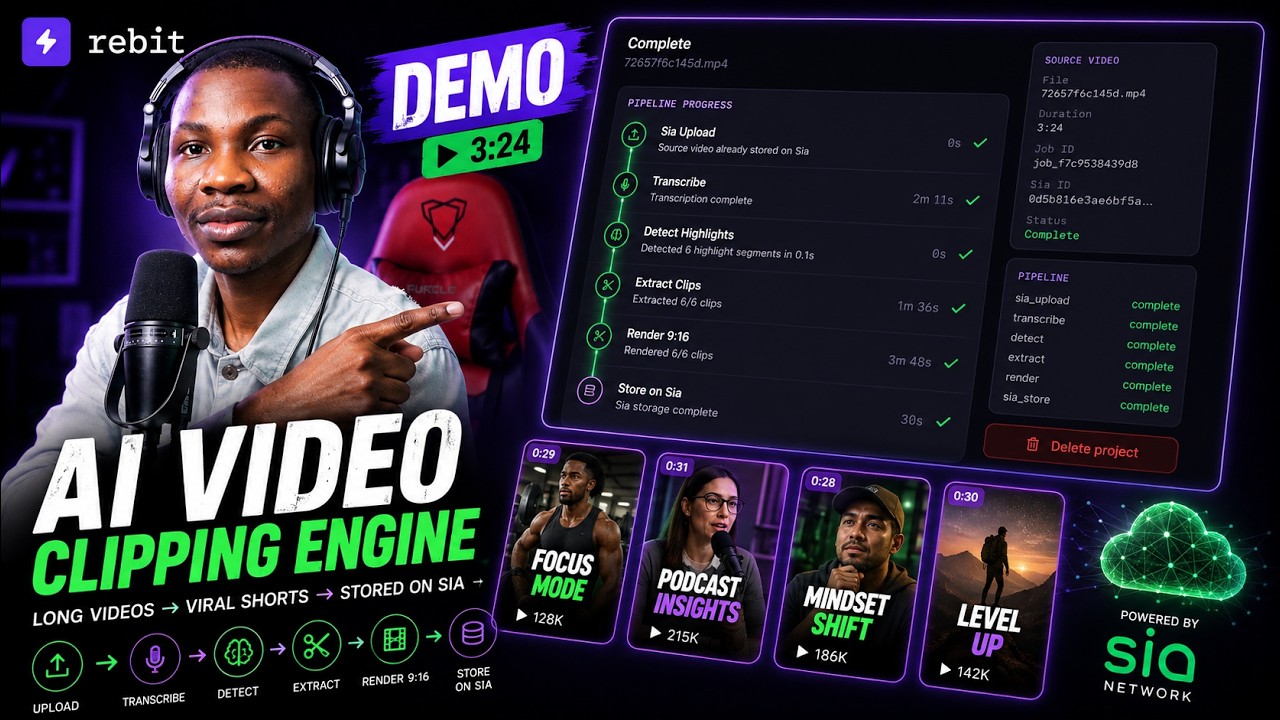
The video shows the full pipeline in action on a real video: upload, transcription, highlight detection, clip extraction, vertical rendering, and storage on Sia. We recommend watching it before reading the architecture section below, since it shows what the milestones in this proposal build on top of.
Describe your project
ReBit is an open-source, self-hostable video processing engine that turns long-form videos into short-form vertical clips. A user uploads a video file or pastes a direct media URL, and ReBit moves it through six automated stages:
Upload → Sia Upload → Transcribe → Detect → Extract → Render → Sia Storage
Every stage runs as an async Python function with its own timeout, progress reporting through Server-Sent Events, and a per-job lock that prevents a single job from running two stages at once. When a stage fails, it reports exactly what went wrong instead of a generic error.
What ReBit does today, already running against the Sia Network:
- Accepts video uploads (MP4, MOV, WebM, MKV, AVI, FLV, OGV up to 500 MB) or direct media URLs
- Uploads the source video to Sia as the first pipeline step, before any processing happens
- Transcribes audio locally with Whisper, no external API involved
- Detects highlights using a multi-strategy heuristic engine (keyword analysis, position in the transcript, and emotional signal detection across eight categories), with an optional LLM enhancement layer
- Cuts clips with FFmpeg and converts them to 9:16 vertical format using OpenCV face detection with saliency-based fallback for non-face content
- Stores every transcript, clip, and the source video on Sia, registered and indexed for retrieval
- Runs entirely through Docker Compose, with a browser-based setup wizard that walks an operator through Sia connection, authentication provider configuration, and account creation
- Falls back to a fully simulated demo mode when Sia is unreachable, so the interface stays usable and testable even before a Sia connection is approved
- Authenticates users through passkeys (Touch ID, Face ID, security keys), Google OAuth, or GitHub OAuth
The frontend runs on Next.js with TypeScript and TailwindCSS. The backend runs on FastAPI with async SQLAlchemy against PostgreSQL. Pipeline orchestration is handled by asyncio tasks with per-job locking, and real-time updates flow to the browser through Server-Sent Events backed by per-job asyncio queues. All Sia operations go through the official Sia Storage SDK.
How does the projected outcome serve the Foundation’s mission of user-owned data? What problem does your project solve?
The dominant tools for content repurposing today, Opus Clip, Descript, and Vidyo.ai, are fully custodial. Every uploaded video sits on a company’s cloud servers in plaintext. Long-form recordings of private interviews, internal product demos, or unpublished lectures carry real privacy risk when they pass through a third-party platform.
ReBit solves this by keeping the entire pipeline self-hosted and user-owned, and this is no longer a claim we’re asking the Committee to take on faith. The demo video linked above shows the source video, transcript, and every generated clip landing on the Sia Network, not on AWS S3, not on a third-party CDN. Recovery requires only the operator’s BIP-39 mnemonic, from which the Sia App Key is derived.
ReBit integrates with Sia exclusively through the official Sia Storage SDK and addresses the Foundation’s stated interest in tools for sharing and viewing large single files such as videos.
Are you a resident of any jurisdiction on the restricted list? No.
Will your payment bank account be located in any jurisdiction on the restricted list? No.
Grant Specifics
Amount of money requested and justification with a reasonable breakdown of expenses
The total requested amount is $26,000 USD, paid across a four-month development term against the milestone schedule below. The full amount covers development labor. We test the platform against a live cloud server throughout development to validate self-hosting under realistic conditions, including multi-user and team deployments.
| Category | Detail | Amount (USD) |
|---|---|---|
| Development labor | One developer, four months; concurrent pipeline architecture, clip extraction strategies, AI model tuning, subtitle and music integration, and production hardening | $26,000 |
| Total | $26,000 |
High-level architecture overview. What security best practices are you following?
ReBit runs as a modular, self-hostable system deployed through Docker Compose, composed of the layers already described above and validated in the linked demo:
Video Ingestion: Handles file uploads and direct media URL imports through the Next.js frontend, with format and size validation before processing starts.
Transcription: Converts audio to a timestamped transcript using Whisper, running locally through FastAPI. No audio data leaves the operator’s infrastructure.
Highlight Detection: Analyzes the transcript with a multi-strategy heuristic engine, scoring segments by hook strength, virality score, and emotional signal, with an optional LLM enhancement pass.
Clip Extraction and Vertical Rendering: FFmpeg cuts segments based on detected highlights, then converts each clip to 9:16 format using a three-tier subject tracking approach: face detection first, saliency detection second, center crop as the final fallback.
Storage: All outputs, including the source video, transcripts, and rendered clips, upload to the Sia Network through the official Sia Storage SDK, with object references persisted to PostgreSQL.
Security practices already in place:
- No user content is sent to external APIs during transcription; all AI inference runs locally
- The Sia App Key is derived from the operator’s BIP-39 recovery phrase and never stored in the database or written to logs
- API keys are stored as SHA-256 hashes and shown only once at creation
- Authentication runs through passkeys (WebAuthn), Google OAuth, or GitHub OAuth, with lazy session initialization so the API returns a clear error state rather than a silent failure before setup completes
- Route protection middleware redirects unauthenticated users to login and redirects incomplete deployments to the setup wizard
Goals and timeline for completion
The MVP proves the core pipeline works end to end on the Sia Network. This grant funds the work needed to move ReBit from a working demo to a system an operator can run in production: concurrent job processing, long-form video support, additional clip extraction modes, subtitle and music features, and the testing needed to trust it under real load.
Milestone 1: Concurrent Processing and Long-Form Video Foundation (Month 1)
Objective: Replace the current per-job lock with a resource-aware concurrent execution model, and add support for processing long-form video sources without exceeding memory or timeout limits.
Deliverables:
- A worker pool pattern replacing the per-job lock in the pipeline orchestrator, running multiple jobs at once while enforcing configurable concurrency limits per stage to avoid resource contention between transcription and rendering
- Resource-aware scheduling that accounts for CPU and GPU load from Whisper and OpenCV, queuing additional jobs once thresholds are reached instead of failing them
- A chunking strategy for long-form sources: videos beyond a configurable duration are split into overlapping segments before transcription and highlight detection, with segment boundaries reconciled afterward so clips are never cut mid-sentence
- Updated job status computation logic to handle concurrent stage execution and mixed completion states across chunks
- A load test harness that runs 10 concurrent jobs, including at least one 90-minute video, against the existing SSE event system to confirm no dropped or duplicated events
Acceptance criteria: A scripted test suite starts 10 jobs at once, including one 90-minute video, all jobs complete without deadlock or resource exhaustion, and the job status and progress reported through SSE match the actual pipeline state at every stage.
Milestone 2: Clip Extraction Strategies and AI Model Tuning (Month 2)
Objective: Add configurable clip extraction strategies and tune the existing transcription, highlight detection, and rendering models against defined targets.
Deliverables:
- Three selectable extraction strategies: Trailer (proportional coverage across the full timeline), Key Moment (concentrates on the highest-scoring segments regardless of position), and Topical (groups segments by subject continuity using transcript similarity)
- Strategy selection exposed through the API and UI, with per-strategy parameters such as target clip count and minimum or maximum clip length
- A benchmark suite establishing baseline metrics for the current heuristic engine against a labeled test set of 20 videos spanning podcasts, lectures, and interviews
- A tuning pass across five dimensions: transcription speed, highlight detection precision, object tracking accuracy in vertical rendering, output quality, and memory usage per concurrent job, each measured against a target set before tuning begins
- Updated documentation covering strategy selection and tuning parameters
Acceptance criteria: All three extraction strategies produce distinct, correctly labeled clip sets from the same source video, and the benchmark suite shows measurable improvement over the Month 1 baseline on at least three of the five tuning dimensions.
Milestone 3: Subtitles, Background Music, and Interface Improvements (Month 3)
Objective: Add subtitle generation and overlay with multilingual translation, background music integration, and interface improvements to the existing review and export screens.
Deliverables:
- Subtitle generation from the existing Whisper transcript, rendered as burned-in or soft-subtitle overlays with configurable styling
- Multilingual subtitle translation covering an initial set of five languages beyond the source language, with a fallback path when a translation fails quality checks
- Background music integration: mood-tagged royalty-free tracks selectable per clip, with automatic audio ducking under speech
- Interface improvements to the pipeline detail view, clip review screen, and dashboard, including clearer error states and stage-level retry controls based on patterns observed during MVP testing
- Updated Sia storage stage that includes subtitle files and music-mixed renders in the final artifact set
Acceptance criteria: A source video processed end to end produces clips with burned-in subtitles in at least two languages and background music correctly ducked under speech, with all new artifacts appearing on Sia alongside the existing outputs.
Milestone 4: Scalability, Resilience, and Production Readiness (Month 4)
Objective: Harden the platform for self-hosted production use under sustained load and complete the testing needed for public release.
Deliverables:
- Load and resilience testing under sustained concurrent job volume, targeting 10 simultaneous jobs, run against a live cloud server to validate multi-user and team hosting scenarios rather than a single local machine, with graceful degradation when Sia or Whisper becomes temporarily unavailable rather than outright job failure
- Retry and backoff logic for each pipeline stage, with clear failure messages surfaced to the user
- A full integration test suite covering every pipeline stage, all three authentication paths, and the setup wizard, running in CI on every commit
- A security review of the self-hosting deployment path, covering Sia App Key derivation and storage, session handling, and demo mode fallback behavior
- Updated README and deployment documentation with a resource sizing guide for a given expected job volume
Acceptance criteria: The platform sustains 10 concurrent jobs without failure or data loss over a six-hour test run, the full CI suite passes, and an external tester following the updated documentation completes a clean deployment and produces a finished, Sia-stored clip within 30 minutes of running docker compose up.
Who is the target user for your project?
The primary user is an independent content creator, educator, developer, or anyone producing long-form video who wants to repurpose it into short-form clips without uploading sensitive content to a third-party platform.
The secondary user is an operator deploying ReBit for a team, studio, or organization on their own infrastructure.
Both users get full data ownership: source videos, transcripts, and generated clips live exclusively on the Sia Network under their own cryptographic control, with no centralized platform holding plaintext content.
What are your plans for this project following the grant?
The repository stays under the MIT license and stays openly developed.
This grant covers what a launch needs. Two features stay deliberately out of scope here and move to future work:
- Studio workspace: a dedicated editing surface with deeper post-processing controls beyond the subtitle and music integration shipped in Milestone 3
- Agentic clip extraction by target audience and personalization: this is new product surface, not a tuning task, and deserves its own scoped grant once the core platform is stable in production
- Edit with Editor mode: manual trim, adjust, and refine controls layered on top of the automated pipeline, for users who want more control before export
We plan to submit a follow-up proposal for these once ReBit has real production usage behind it.
Potential risks that will affect the outcome of the project
Concurrency refactor risk. Moving from a per-job lock to true concurrent execution touches the orchestrator, database writes, and the SSE event system directly.
Mitigation: the worker pool and resource-aware scheduler in Milestone 1 are built and load-tested before any other milestone depends on them, and the acceptance test explicitly checks for deadlocks and event integrity under concurrent load.
AI model tuning without a moving target. Optimization work has no natural stopping point unless targets are fixed in advance.
Mitigation: Milestone 2 opens with a benchmark suite and defined targets across all five tuning dimensions before any tuning work starts, so progress is measured against fixed numbers rather than open-ended improvement.
Multilingual translation quality. Translation accuracy varies by language pair and can misrepresent the source content if left unchecked.
Mitigation: the initial language set is limited to five well-supported pairs, and a quality check fallback prevents a bad translation from silently shipping.
Scalability under real load is unproven until tested.
Mitigation: Milestone 4 runs a six-hour sustained load test at 10 concurrent jobs as an explicit acceptance criterion, not an afterthought.
Development Information
Will all of your project’s code be open-source?
Yes. The entire codebase is released under the MIT License.
Proof of technical experience with the Sia Storage SDK
The clearest evidence we can offer is the 3:24 demo linked at the top of this proposal. It shows ReBit’s complete pipeline running against the Sia Network today: Sia upload, transcription, highlight detection, extraction, vertical rendering, and final storage, all against a real video, not a mockup. This is the system the milestones in this proposal build on, not a plan that still needs to be validated.
Repository: GitHub - Dapp-Mentors/rebit: ReBit is an open-source, self-hostable video processing engine that transforms long-form videos into multiple short-form vertical clips. It is designed to be fully user-owned, privacy-preserving, and operable without mandatory platform fees or centralized cloud dependencies. · GitHub (currently private; will be made public upon grant approval, per our usual practice on active builds)
Before ReBit, we built and shipped OpenBucket, a working file pinning application built on the official Sia Storage SDK. OpenBucket uses the JavaScript SDK rather than the Python SDK ReBit is built on, but the two are not meaningfully different in how they handle uploads, pinning, and object retrieval, so the experience carries over directly. OpenBucket is not a proof of concept either; it is a fully functional, open-source app runnable with a single docker compose up.
Repo: GitHub - Dapp-Mentors/open_bucket: OpenBucket lets you upload a file, watch it go through pinning on Sia + Indexd, and then download it later. Everything feels event-driven with visible progress. Local storage keeps your file records (just URLs and metadata) so it remembers what you've done in the browser. · GitHub
Demo video: https://www.youtube.com/watch?v=gr8vbJhqoEA
This builds on our track record with Sia. Our two completed grants, SiaLearn and SiaPeopleLearn, were delivered on schedule and built on Renterd. The SiaLearn grant also produced a 12-video educational playlist that has helped developers understand how to build on the Sia network: https://www.youtube.com/playlist?list=PLUDcVqFK2t-CZJZ5ihfrVHtLkDhZlLYO-
Do you agree to submit monthly progress reports?
Yes. We will submit a monthly progress report here on the forum covering each milestone’s deliverables.
Contact Info
Organization: Dapp Mentors
Email: [email protected]
LinkedIn: https://www.linkedin.com/in/darlington-gospel