Introduction
Project Name: CloudBridge
Organization: Dapp Mentors
Background
Dapp Mentors is a two-time Sia Foundation grant recipient specializing in developer tooling and decentralized infrastructure. Our previous grants delivered SiaLearn and SiaPeopleLearn, both built on Renterd.
This proposal is a deliberate, focused step. Following the Committee’s direction and the Foundation’s current funding focus, CloudBridge will be built directly on the indexd + Sia Storage SDK pathway, while delivering something useful for everyday users right now.
Describe Your Project
CloudBridge is a self-hostable, open-source web application that gives users a clean graphical interface to migrate and back up data from Google Drive and local filesystem directly into Sia using the Sia Storage SDK and indexd.
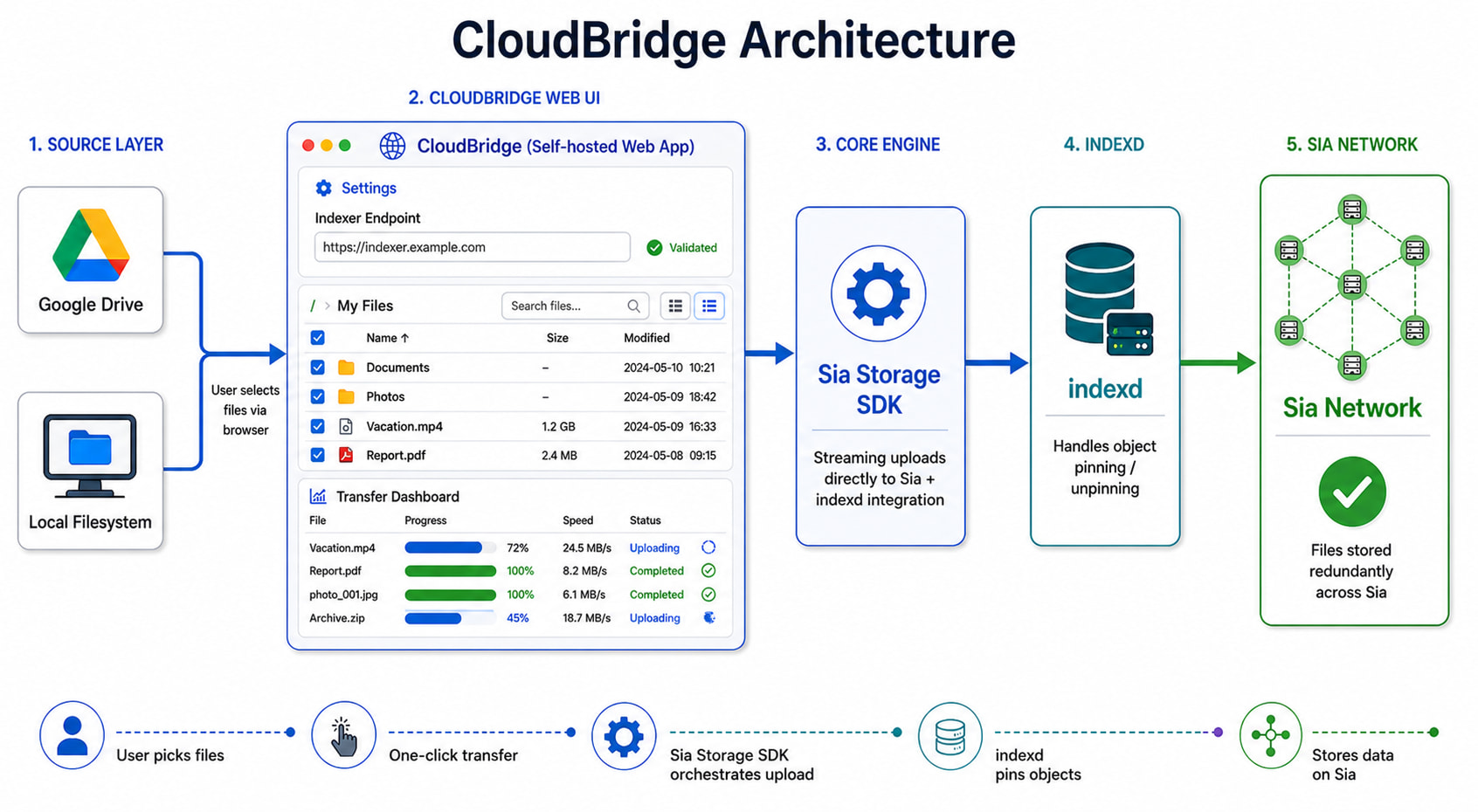
CloudBridge wraps the indexd + SDK stack in a simple browser-based UI. Users connect to their indexer endpoint once, pick files from Google Drive or their local machine, and start secure streaming transfers without needing to install or operate command-line tools.
Today, getting files into Sia mostly still involves technical hurdles that block non-developers. CloudBridge reduces this to a guided flow inside a browser:
- Connect to your indexer once
- Select files visually
- Start transfer with one action
This is scoped as a minimal working proof of concept within a small grant. The goal is to prove the data migration use case is real, show that our team can deliver reliably on Sia’s current tools, and validate demand for a simplified user-facing layer.
Core Capabilities:
-
Indexer endpoint setup with connection validation
-
Google Drive and local filesystem connectors
-
Simple file browser to preview and select what to transfer
-
Streaming uploads via the Sia Storage SDK with no disk-side plaintext staging
-
Background transfers with basic status tracking
-
Simple job persistence using a local JSON file
-
Object pininig/unpinning via indexd, visible on dashboard
-
One-click download button for uploaded files
-
Docker-based one-command self-hosted deployment
Evidence of Demand
CloudBridge targets a real and documented gap: there is currently no simple, open-source web UI built natively on the Sia Storage SDK and indexd that lets non-technical users migrate their data into Sia without touching a terminal.
-
Sharing and migrating large files: Moving large datasets, media libraries, and backups remains a core need for users evaluating Sia.
-
Avoiding vendor lock-in: Platforms like SproutVideo charge per-seat pricing, while tools like Pixeldrain lack open-source extensibility. Users actively look for open-source alternatives they can control.
-
Community validation: Self-hosting communities continue to discuss backup, migration, and storage portability challenges, especially for users leaving centralized providers.
-
Ecosystem gap: The Sia Storage SDK and indexd exist and work well, but there is no simple, open-source web app built specifically to onboard everyday users into this flow.
Target Users
-
Business owners and non-technical decision-makers
-
Content creators (filmmakers, educators, digital artists)
-
Self-hosting enthusiasts who prefer UI-driven tools
-
Developers exploring Sia but not yet comfortable with SDK workflows
-
Privacy-focused everyday users
How Does This Serve the Foundation’s Mission?
The Committee has made it clear that migrating and sharing large files without vendor lock-in is a top priority, and that the indexd + SDK pathway is the current direction for funded projects. CloudBridge lowers the barrier for users who want to move their data into Sia but are currently blocked by tooling complexity.
Each successful transfer represents real user data moving from centralized systems into user-owned, decentralized storage on the Sia network.
Compliance Questions
Are you a resident of any jurisdiction on that list? No
Will your payment bank account be located in any jurisdiction on that list? No
Grant Specifics
Amount Requested: $8,500 USD
Timeline: 2 months
| Category | Cost (USD) | % | Justification |
|---|---|---|---|
| Core backend & SDK/indexd integration | $5,300 | 62.35% | Sia Storage SDK integration, indexd pinning, streaming transfer engine, job queue |
| Frontend UI/UX | $2,000 | 23.53% | File browser, transfer dashboard, settings, and onboarding |
| Testing, QA & documentation | $600 | 7.06% | End-to-end tests, error handling, README, and self-hosting guide |
| Infrastructure & DevOps | $600 | 7.06% | Docker setup, CI pipeline, GitHub repo configuration |
| Total | $8,500 | 100% |
Goals and Timeline
Month 1: Foundation & Connectors
Due: June 30, 2026 (Repo setup, indexer connection, connectors, and transfer engine)
-
GitHub repo is public with CI pipeline, basic README, and open-source license
-
Users can add and validate their indexer endpoint connection via the configuration module
-
Google Drive connector lets users browse and select files/folders
-
Local filesystem connector supports folder and file selection
-
Selected files are uploaded to Sia via the SDK streaming pipeline with live status shown in the UI
-
Uploaded objects are pinned via indexd and visible in the dashboard
-
Basic transfer logs are visible per job
Month 2: Stability, Polish & Release
Due: July 30, 2026 (Logs, persistence, onboarding, testing, and docs)
Weeks 1-2: Remaining Development
-
Simple job persistence is operational so transfer status survives restarts
-
Basic error handling and retry for failed transfers are functional
-
Guided onboarding flow from indexer setup to first transfer is complete and functional
Weeks 3-4: Testing, Documentation & Release
-
End-to-end test suite passes for both Google Drive and local filesystem flows
-
Failure scenarios tested: invalid indexer endpoint, connection drops, interrupted transfers
-
Docker Compose deployment tested on a clean Ubuntu server
-
Complete self-hosting guide published in the repo
-
Technical documentation covering setup, configuration, and usage
-
v1.0 release tagged on GitHub with clear usage instructions
Post-Grant Plan
CloudBridge will be our first delivered tool built natively on the Sia Storage SDK and indexd. A successful v1.0 means real users can move files from Google Drive into Sia without touching a terminal, and we will have the deployment data and feedback to back it up.
Future work will be evaluated based on real usage, feedback, and demonstrated demand. Any follow-up proposal will be grounded in feedback from actual users and deployments.
Risks
-
Sia Storage SDK or indexd API changes: Mitigated through an abstraction layer that isolates SDK calls from core application logic, allowing targeted updates without major rewrites.
-
Google Drive API changes: The Google Drive API is mature, so major breaking changes are unlikely within a 2-month window.
-
Indexer availability: Mitigated by configurable fallback and retry mechanisms within the upload queue.
Development Information
Open-source: Yes. All code will be publicly licensed from day one.
Repository:  CloudBridge Repo
Agreement: Yes, we agree to submit monthly progress reports using the official Sia Foundation template.
Contact:
Email: [email protected]
 . And right now